
Showing posts with label wooden boat. Show all posts
Showing posts with label wooden boat. Show all posts
Wednesday, June 29, 2016
PHOENIX MEMORABILIA: Inflatable world globe


Tuesday, June 28, 2016
PHOENIX MEMORABILIA: Chronometer

On the boat, it had just looked like an old box. My husband, pleased with its potential, went to some trouble to polish it, restoring it to its original lustre and beauty. I was amazed at the transformation.

 When Skipper saw it, however, he was disgusted. It had probably not looked that sleek when he bought it (at Army surplus!) and years of sun and salt water had only made it more weather-beaten. Now, he humphed, it was "sissy." It had lost all its rugged uniqueness as something that had endured the Phoenix circumnavigation.
But I cherish it, both for its history and for its workmanship. The clock face is set in gimbals. You can lift one lid that allows you to read the time while the clock is still protected by glass. Another, lower lid enables you to get at the clock to set it.
In the picture below (which in the more somber lighting makes the chronometer look closer to what I remember it looking like on the boat), Jerry is tipping the clock face forward for you.

Monday, June 27, 2016
PHOENIX MEMORABILIA: Sextant - lost

Neither Ted nor I know what happened to the sextant he and Skipper used during the voyage around the world. In a documentary, Voyage of the Phoenix, made by William Heick for Canadian Broadcasting in 1967, Skipper was using what I'm sure was the same sextant on the way to North Vietnam, long after our trip around the world.
Here's Ted taking readings.
 But we don't know where it is now.

Sunday, June 26, 2016
PHOENIX MEMORABILIA: Parallel calipers
 See that light-colored stick thing on the lower right hand corner of the desk? Dad and Ted would walk this instrument across the charts to find our position. (Once when they didn't have the right chart, our position was halfway up Mt. Fuji.)
I want to call the thing "calipers" or parallel bars but I know that can't be right. It's for making parallel lines.
I think the one in this picture is the one we still have. (See below.)

Here's Skipper using a similar one at the desk in his cabin. I assume they used several over the years. They are probably pretty cheap.

Saturday, June 25, 2016
PHOENIX MEMORABILIA: Compass - lost

This is a terrible picture of the compass. All it shows is its location in the cockpit, aft of mizzen mast, with Skipper's foot supporting our original cat Mi-ke's paws and Skipper's hand holding the tiller. On the bright side, however, it is a very good picture of Mi-ke.
Friday, June 24, 2016
PHOENIX MEMORABILIA: Tiller

Wait, I found another picture of it:

Thursday, June 23, 2016
PHOENIX MEMORABILIA: Life raft - lost

En route to Tahiti, Skipper relaxing in the life raft. (This is posed--he never really relaxed).

Wednesday, June 22, 2016
PHOENIX MEMORABILIA: Life preserver

Tuesday, June 21, 2016
PHOENIX MEMORABILIA: Block


Monday, June 20, 2016
PHOENIX MEMORABILIA: Riding lights

Looks like it must have been laundry day.
I gave one or both of the lights to our son and they are probably in storage.
Sunday, June 19, 2016
PHOENIX MEMORABILIA: Bamboo ware

These are all that's left of our Phoenix "silver"ware but this may be most of it--four place settings, a grapefruit spoon and a pickle fork. I think I could probably fill in what's missing from Pier 1 Imports.
Saturday, June 18, 2016
PHOENIX MEMORABILIA: "Souvenirs hung from bulkheads and overhead"
This is the ladies' cabin, where we served coffee to the crew of the Golden Rule. As Bert Bigelow mentioned in his book, The Voyage of the Golden Rule, "the bulkheads and even the overhead were hung with all kinds of souvenirs from all over the world."
 I don't remember where we got the stuffed crocodile but it was on the wall over Mum's bunk.
We also had two things dangling from the ceiling. One was a woven capsule of dried palm or pandanus leaves about six inches by three inches--like a large sausage--in which, we were told, was dried banana. This was how Polynesians carried their food when they made long voyages in their catamarans. Ours eventually disintegrated but not for years.
The other thing was a small blowfish, inflated, maybe eight inches across.
Facing Mum, over the doorway to the main cabin, is the wooden carving of a Japanese scene and behind and above her is the tokonoma, both of which I will be telling you about in the next few days.
The cat is Mi-ke's daughter, Manuia (Lucky in Tahitian).
PHOENIX MEMORABILIA: Doorway decor

Friday, June 17, 2016
PHOENIX MEMORABILIA: Kerosene lamps

(I'm cheating here. Not only didn't I polish the brass for this photo but the lamp is not really vertical or attached to the wall. I laid the lamp on a canvas sack on the floor and held up its tail with one hand as I took the picture with the other. Then I turned the picture upright.)
The one on the wall of the ladies' cabin in yesterday's picture was a little different. I don't remember for sure which style came first.
Thursday, June 16, 2016
PHOENIX MEMORABILIA: Tokonoma
You may not recognize the word "tokonoma" but you've seen them in pictures of Japanese homes. It's sometimes called a "God-shelf." It's usually in the main room of the home, inset in a wall facing the main door, almost floor to ceiling. It may be divided in half vertically; the left alcove will feature a long wall-hanging and below that a large floral arrangement. The right may have various shelves or drawers but it too will be artistic and restful.
Devout Buddhists (or is it Shintoists? Japanese blend the Buddhist philosophy and the Shinto ancestor worship into one religious tradition) may put a plate of three oranges or of white or pink rice patties (mochi) on one of the shelves in deference either to gods or ancestor.
We had a tokonoma on the Phoenix, high on the wall of the "ladies' cabin," on the wall just aft of my mother's bunk. It was maybe two feet by three feet and divided by a cherry log perhaps an inch thick. We had a miniature wall hanging made for it before we left Japan. I wish I could remember what else we had in it--I must have looked at it hundreds of times but I can't remember and the tokonoma and everything in it has disappeared. I can't find a single photograph of it, even in the background of a photo of something else but here is a full-sized one from Pinterest.
Wednesday, June 15, 2016
PHOENIX MEMORABILIA: Plaques and carvings
We had two small metal plaques. One was in the head and had the operating instructions for the toilet: ". . . pump with short strokes to empty the bowl." The other says, "Pasop vir die hond" which I understand means "Beware of the dog" in Afrikaans. We probably bought it at Groot Constantia, a winery in South Africa.
Ted has both of them--plus a row of assorted carved tiki's along a window sill. He's promised to look for someone to take pictures of them and email them to me to post here.
Ted has both of them--plus a row of assorted carved tiki's along a window sill. He's promised to look for someone to take pictures of them and email them to me to post here.
Monday, June 13, 2016
PHOENIX MEMORABILIA: Mah-Jongg game


 |
| Bamboo |
 |
| "Dots" or "wheels" |

 |
| Characters ("cracks") |

 |
| Winds |

 |
| Flowers and seasons |

 |
| 4 dice and red thingy showing winds |

 |
| Fancy box we keep the Mah-Jongg set in. |

Sunday, June 12, 2016
PHOENIX MEMORABILIA: Rice paddle
 |
| Close-up |
I have never had occasion to cook this much rice at one time.
 | |
| Front |
 |
| Back |
 |
| Handle |
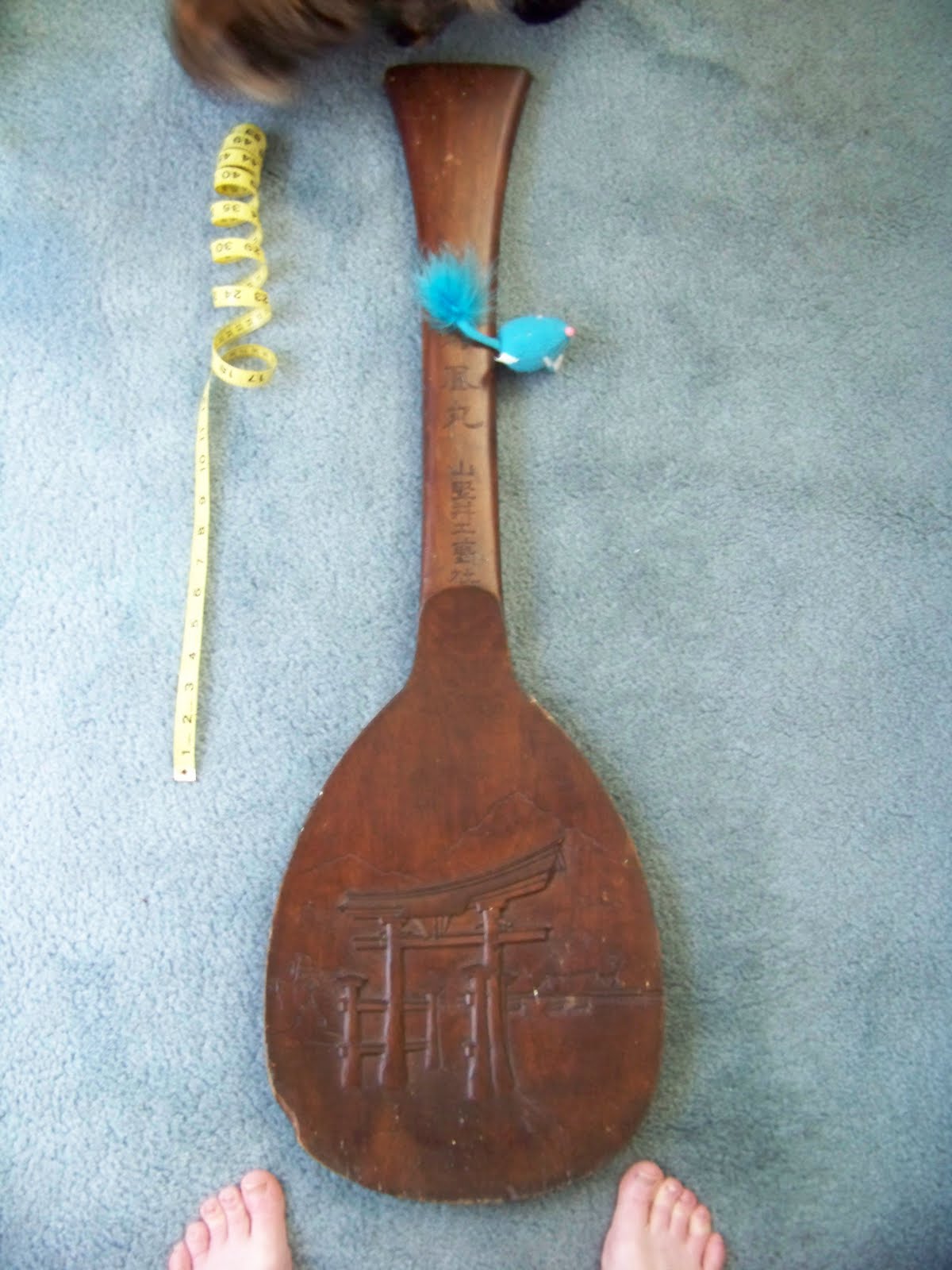 |
| Here comes Sudoku, after her mouse. I'm losing my concentration. Those are my feet. |
 |
| Sudoku, you are NOT Phoenix memorabilia! |
 |
| You weren't even ON the Phoenix!. |
 |
| Sigh. |
Saturday, June 11, 2016
PHOENIX MEMORABILIA : Glass ball

Friday, June 10, 2016
PHOENIX MEMORABILIA: Victrola record player - lost

 This photo shows just a glimpse of it on the cabin top right behind my left shoulder: the box holding it, the edge of a record on the turntable and the shiny metal crank. This was in 1955, when the boat was at the dock in the village of Haapu, on the island of Huahine in the Society Islands. (I did the Hawaiian hula and some of their young people did Tahitian ones.)
In All in the Same Boat, Dad writes, "In Haapu we had our first taste of real entertaining. It was simple to issue invitations: we just sent Jessica up on deck with the portable photograph and told her to start playing records. Within minutes villagers had begun to gather and soon the party was in full swing. Breaking it up was not so easy, for in spite of frequent showers and the coming and going of the dinner hour no one deserted.
"The dancing--both Tahitian and modified European--took place beside the boat, on the dock. After each dance the men boarded the boat to squat around and talk, while the girls retreated down the dock to the shadows of the road. With the beginning of a new tune the men would seek out their partners and lead them back into the lighted area around our pressure lantern. During the frequent showers, everyone crowded aboard and took giggling refuge below so that, at times, we had over a hundred people packed into the cabins, the bunks, and the aisles, examining our possessions as they waited for the rain to stop and making excited comments about our accommodations.
"Nothing, I hasten to add, was missing when the last guest had finally gone, but the next day our ship's inventory was increased alarmingly by gifts of bananas, breadfruit, necklaces of shells, carvings of wood and coconut, and hats of woven pandanus." New York: David McKay Company, Inc., 1962, p. 90.
The only records I remember from that time are Kiss of Fire, the Nutcracker Suite, and the Blue Danube. Even when we moved to Japan when I was seven, I preferred the latter two and I have like classical music ever since.
Subscribe to:
Posts (Atom)